
 News
In the long river of the automotive industry, the importance of the braking system as a core component of vehicle active safety is self-evident. It is not only a key device for vehicle deceleration and parking, but also the last line of defense to protect the safety of drivers and passengers in emergency situations.
1、 Principles and Components of Automotive Braking Systems
In short, the working principle of a car brake system is to convert the vehicle's kinetic energy into thermal energy through the driver's operation, thereby achieving deceleration or parking. The braking system mainly consists of four parts: brake, brake transmission system, brake control system, and brake assist system.
Brakes: Components that directly act on the wheels, commonly including disc brakes and drum brakes. Disc brakes generate braking force by clamping the brake disc with friction plates inside the brake caliper, which has the advantages of fast heat dissipation and stable braking efficiency; Drum brakes use the friction between the brake shoes and the inner wall of the brake drum to generate braking force, with a relatively simple structure and lower cost.
Brake transmission system: including brake master cylinder, brake pipeline, brake valve, etc., responsible for converting the driver's braking command into mechanical force and transmitting it to the brake.
Brake control system: composed of brake pedal, brake booster, brake distributor, etc., it controls the braking force and distributes the braking force to ensure the smoothness and safety of braking.
Brake assist systems, such as ABS (Anti lock Braking System), ESP (Electronic Stability Program), etc., monitor the vehicle's status in real-time through an electronic control unit, adjust braking force, prevent wheel lock up and vehicle loss of control, and improve driving safety.
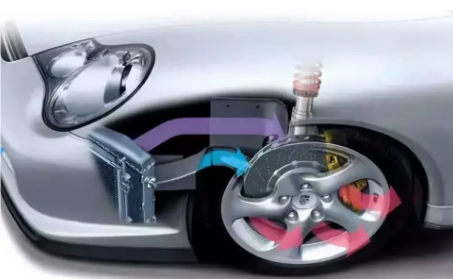
Image article from the internet. If there is any infringement, please contact us for deletion
2、 Characteristics and advantages of brake system
High safety: The braking system is one of the most important safety systems in a car, directly related to the safety of the driver and passengers. Its high reliability and precision ensure that the vehicle can quickly brake and maintain stability in emergency situations.
Controllable braking force: The braking system can flexibly control the braking force and braking distance according to the driver's needs, adapting to different road conditions and speed conditions.
Easy to operate: The controller and operating components of the brake system are designed to be simple and clear, making it easy for drivers to operate and accurately control the vehicle's braking.
Efficient and energy-saving: Modern brake systems improve braking efficiency and reduce energy consumption by continuously optimizing design and adopting advanced technologies such as hydraulic transmission and electronic control.
With the rapid development of the automotive industry, the application scenarios of brake systems are becoming increasingly widespread, from household cars to heavy-duty trucks, from ordinary roads to track competitions, brake systems play a crucial role. In this field, Zhuzhou Jingde Machinery Co., Ltd. has demonstrated strong professional capabilities and advantages through its profound accumulation and innovative capabilities in the field of mechanical manufacturing.
The performance of the braking system is directly related to the driving safety and handling of the vehicle. To improve vehicle performance and safety, car owners and manufacturers can optimize the braking system through the following methods:
Choose high-performance brake pads: High performance brake pads have better friction coefficient and wear resistance, which can significantly shorten the braking distance and improve the braking effect.
Upgrading brake discs: Adopting lightweight and high heat dissipation brake discs, such as ceramic brake discs, can effectively reduce the heat generated during braking, improve braking stability and durability.
Install brake assist systems such as ABS, ESP, etc., which monitor the vehicle's status in real-time through an electronic control unit, automatically adjust the braking force, and prevent wheel lock up and vehicle loss of control.
Regular inspection and maintenance: Regularly inspect and replace vulnerable parts such as brake pads and brake discs to maintain the good working condition of the brake system and ensure driving safety.
The braking system of a car is the key to safeguarding driving safety. Its importance is not only reflected in daily driving, but also plays an irreplaceable role in emergency situations.